
Measure the outcome after the click
To measure WhatsApp campaign ROI, connect campaign delivery to qualified actions and completed sales, then compare attributable contribution with the full campaign cost. Delivery and read rates help diagnose the funnel; they do not by themselves show that the campaign made money.
A useful report answers four questions: who was eligible, who received the message, what action they took and what financial result followed. The same framework works for ecommerce orders, appointment bookings and sales opportunities, provided the team defines the outcome before launch.
This is an implementation playbook with illustrative calculations, not a Botinx customer case study or a promise of specific returns. Pricing references were checked on 7 November 2026. Use your actual invoice and order data in the final report.
Define the funnel and denominator before sending
| Metric | Suggested calculation | What it tells you |
|---|---|---|
| Delivery rate | Delivered messages / attempted messages | Whether the send reached recipients. |
| Observed read rate | Messages with read events / delivered messages | Available reading evidence, not complete attention. |
| Unique click-through rate | Unique tracked clickers / unique delivered recipients | How many reached people acted on the link. |
| Reply rate | Unique replying recipients / unique delivered recipients | Conversation response. |
| Click-to-purchase conversion | Attributed purchasers / unique tracked clickers | Performance after the click. |
| Delivered-to-purchase conversion | Attributed purchasers / unique delivered recipients | End-to-end performance for the reached audience. |
| Cost per acquired customer | Campaign cost / attributed new customers | Acquisition cost; do not include repeat buyers as new customers. |
Choose whether you are counting messages, people, orders or customers and label the report accordingly. One person may receive two messages and place two orders. A report that silently mixes those units can appear to improve even when performance is unchanged.
Read receipts are not complete evidence of attention. Likewise, repeated clicks are not additional customers. Keep total events and unique people as separate columns instead of using whichever produces the larger headline.
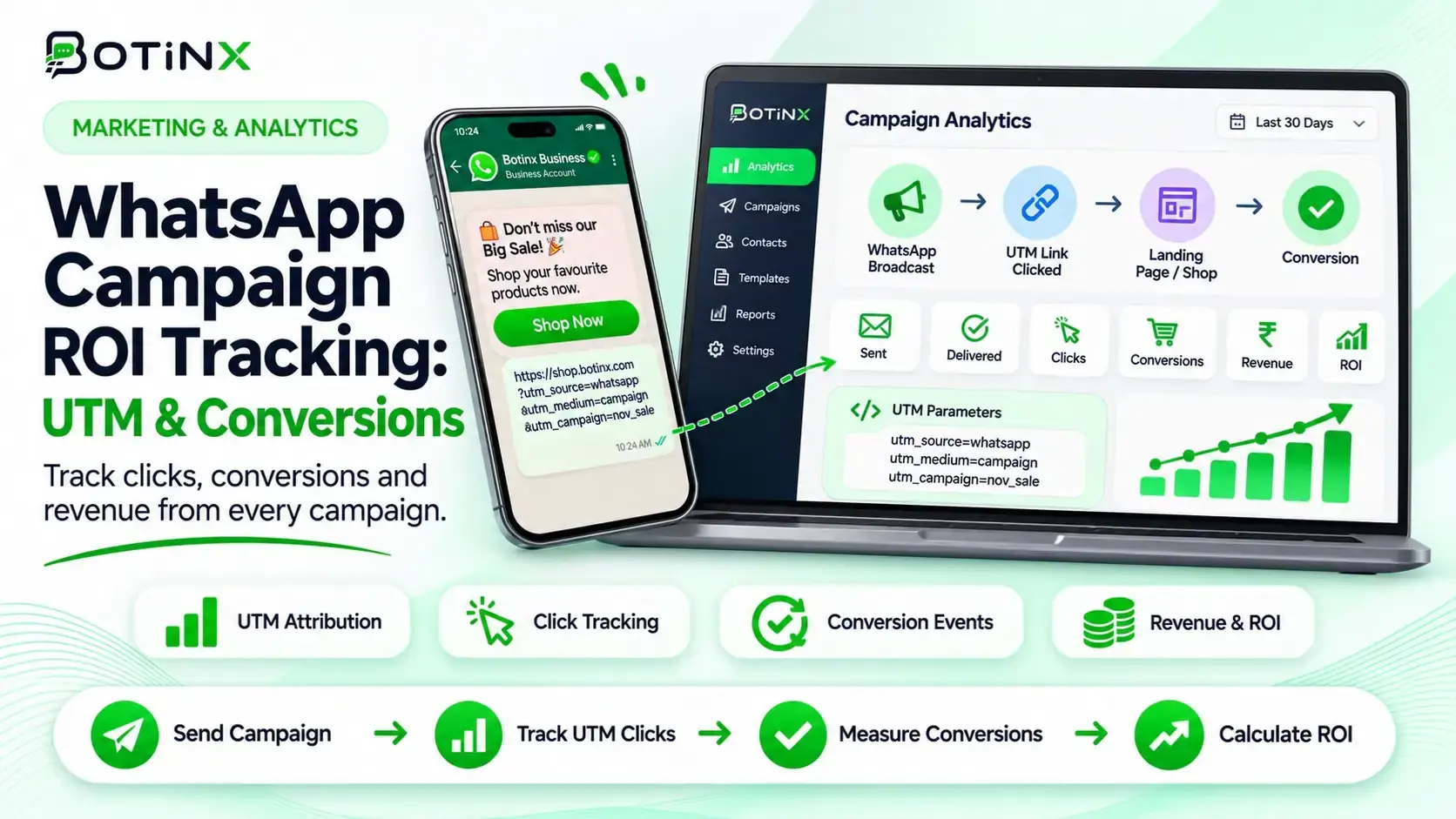
Add UTMs to links that lead to your website
For a broadcast linking to a product page, use consistent campaign parameters. An illustrative URL is:
https://example.com/collections/new-arrivals?utm_source=whatsapp&utm_medium=messaging&utm_campaign=nov_launch_2026&utm_content=recent_buyers_aHere, source identifies the channel, medium identifies the communication type, campaign groups the launch and content distinguishes a segment or message variant. Choose a naming convention your team can maintain. Avoid changing capitalization and spelling between versions.
Test the complete journey on a phone: open the message link, follow any redirect, browse the landing page and complete a test conversion in the appropriate test environment. Confirm that the parameters reach analytics and that the order can be connected to the intended campaign.
Do not place phone numbers, names, email addresses or other personal data in UTMs. URLs can appear in browser history, analytics systems and logs. Use campaign or segment labels rather than customer identities.
These parameters describe website visits from a WhatsApp link. They do not automatically prove which inbound WhatsApp conversation produced an offline sale. That requires a separate connection through your CRM or order process.
Connect chats and orders without double-counting
Create a campaign identifier and carry it through your reporting workflow. Where possible, connect a known conversation or click to the resulting lead and order using your authorised internal identifiers. Restrict access to customer-level data and publish aggregated results to the wider team.
For sales completed inside a conversation, ask the agent to record the opportunity source and final outcome consistently. Use “qualified,” “won,” “lost” and “still open” according to written definitions. A friendly reply should not automatically become a qualified lead.
Choose an attribution window before launch. For example, you might count a purchase within seven days of the tracked campaign interaction for a short buying cycle. That seven-day example is a business reporting choice, not a universal Meta rule. Longer consideration cycles may need a different window.
Define what happens if the customer also clicks an email or paid ad. A last-touch report and a multi-touch report can both be useful, but they answer different questions. Do not add their attributed revenue together as though they represent separate orders.
Deduplicate using a stable order identifier. Repeated webhooks, multiple payments or a refreshed confirmation page should not create new conversions. Subtract cancellations and refunds according to the reporting policy rather than presenting gross bookings as final revenue.
Include the actual cost of the campaign
Meta’s current platform pricing is based on delivered messages, with rates depending on market and category and with applicable free-message provisions. Do not estimate every campaign using an old per-conversation formula. Use the official WhatsApp pricing page and your actual billing records.
- Meta messaging charges for the campaign.
- Provider charges and a documented share of the platform subscription.
- Creative preparation and campaign setup time.
- Agent time spent on the resulting conversations.
- Any paid acquisition spend explicitly included in the campaign scope.
Be clear about whether discounts, shipping subsidies and payment fees are deducted in the order contribution or counted elsewhere. Include them once. Counting them twice understates profit; omitting them exaggerates it.
If your subscription supports several channels and campaigns, explain how you allocated the cost. A simple consistent allocation is more useful than a different rule every month. Report a messaging-cost-only efficiency number separately if the team also needs it.
Worked example: revenue efficiency is not profit ROI
Illustrative numbers only: a campaign attempts delivery to 10,000 eligible recipients. It reaches 9,000, produces 900 unique tracked clickers and leads to 90 attributed purchases. Net revenue after refunds is ₹1,80,000. The contribution margin before campaign costs is 40%, and the total campaign cost is ₹20,000.
| Calculation | Result |
|---|---|
| Delivery: 9,000 / 10,000 | 90% |
| Unique click-through: 900 / 9,000 | 10% |
| Click-to-purchase: 90 / 900 | 10% |
| Delivered-to-purchase: 90 / 9,000 | 1% |
| Attributed revenue / campaign cost | 9× revenue-to-cost ratio |
| Contribution: ₹1,80,000 × 40% | ₹72,000 |
| Contribution after campaign cost | ₹52,000 |
| Contribution-based ROI: ₹52,000 / ₹20,000 × 100 | 260% |
The 9× figure is not the same as profit ROI. It compares revenue with campaign cost. The 260% figure incorporates the stated contribution margin, but still depends on the attribution model. If some buyers would have purchased anyway, it is not proof of incremental lift.
At ₹800 contribution per order before campaign cost, the campaign needs 25 additional orders to cover ₹20,000. That break-even calculation can be more useful for planning than chasing a generic industry click benchmark.
Use a holdout to estimate incremental impact
If audience size and business constraints permit, randomly reserve a comparable group that will not receive this promotional campaign. Keep essential service messages running normally. Compare purchase outcomes over the same period and account for other promotions reaching either group.
Illustrative example: 10,000 randomly assigned treatment customers have a 2% purchase rate, while 1,000 holdout customers have a 1.5% rate. The observed difference is 0.5 percentage points, equivalent to about 50 additional purchases if applied to the 10,000 treatment customers. This is an estimate, not proof of significance or a guaranteed future effect.
Keep the treatment denominator based on random assignment when estimating impact. Restricting it to only delivered recipients after assignment can introduce selection bias. Separately report delivered-recipient conversion for operational diagnosis.
Small groups and rare purchases produce noisy results. Repeat the comparison across suitable campaigns and avoid declaring a winner from a few extra orders. Record the experiment plan before seeing the outcome so the attribution window does not change to favour the result.
Turn the report into the next campaign decision
If delivery is weak, inspect failures by code before rewriting the offer. If delivery is healthy but clicks are weak, review audience relevance, the first sentence and the call to action. If clicks are healthy but purchases are weak, inspect the landing page, pricing, stock and checkout process.
If replies increase but sales stall, review response time and the handoff to agents. A campaign can generate demand faster than the team can handle it. If sales rise but contribution falls, inspect discounts and support costs before increasing the send volume.
For a Botinx workflow, start with available campaign reporting, then reconcile it with website analytics and order or CRM records. Do not assume a single dashboard automatically calculates incremental profit or offline attribution.
Review delivery-error handling and permission-based audience checks before scaling an apparently successful campaign.
Frequently asked questions and sources
What is a good WhatsApp click-through rate?
Use a comparable baseline from your own audience, offer and denominator. This guide does not claim a universal benchmark.
Can UTMs track sales completed in a WhatsApp chat?
UTMs identify tagged website traffic. A chat-only or offline sale needs an additional CRM or order connection.
Are read rates reliable revenue metrics?
No. They are supporting signals with visibility limits. Measure the outcome after the read.
Is attributed revenue the same as incremental revenue?
No. Attribution assigns credit under a chosen rule; a suitable holdout helps estimate what changed because of the campaign.
Reference material: Meta platform pricing; Google Analytics campaign URL parameters; respond.io documentation on broadcast metrics and read-receipt visibility. The formulas, example and operating recommendations above are original illustrative analysis.
Talk to Botinx about mapping campaign delivery to your existing lead and order reporting.