
What WhatsApp confirmation can help with
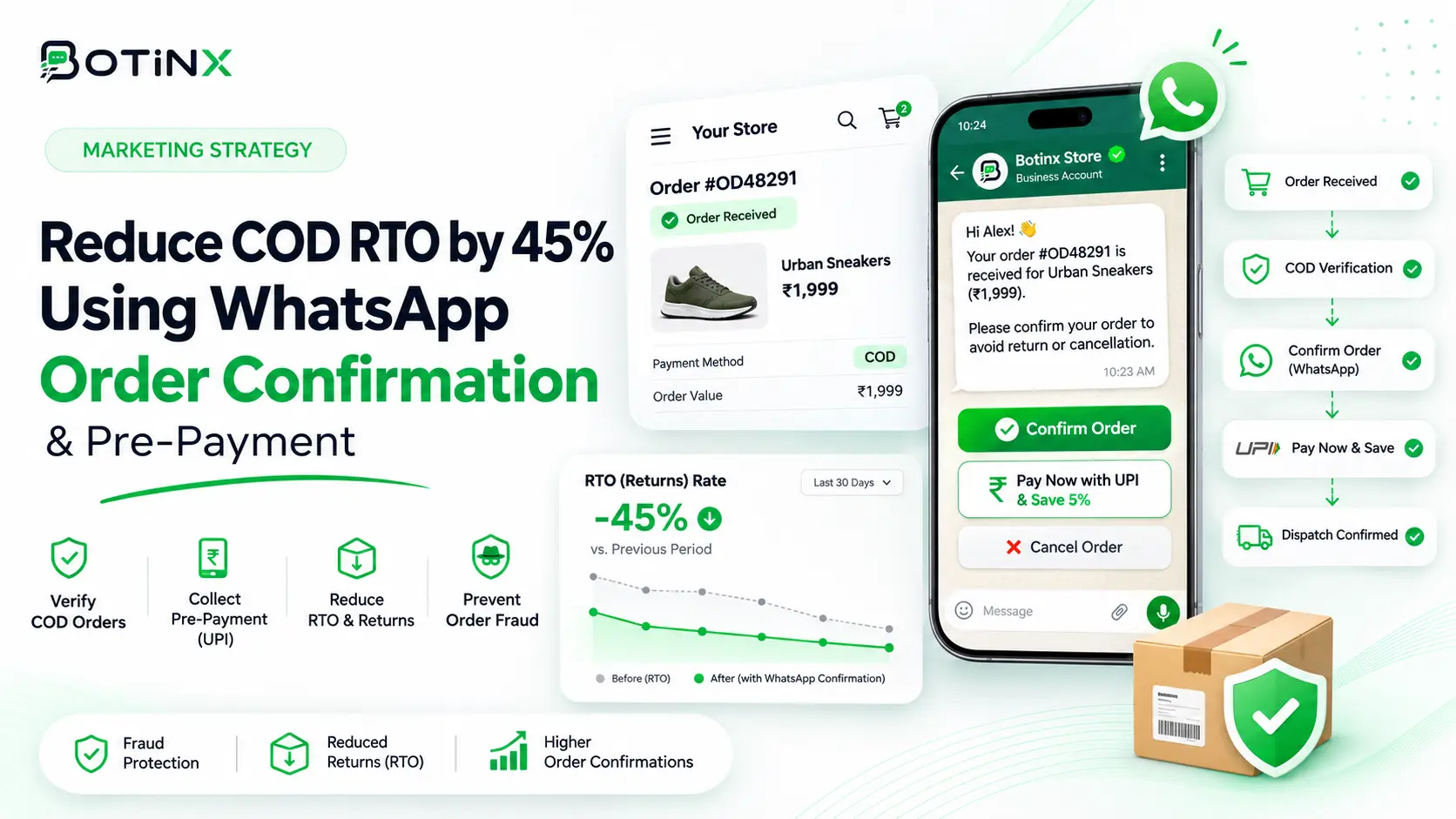
Cash-on-delivery orders can return to origin for several reasons: incorrect addresses, unavailable customers, changed purchase intent or delivery problems. A confirmation conversation can clarify intent and correct some information before dispatch. It cannot guarantee delivery or identify every fraudulent order.
Use Botinx's Shopify workflow and team inbox to evaluate a process suited to your store. Define the operational goal carefully: reduce avoidable shipping losses while preserving genuine orders. Automatically cancelling every unanswered message may reduce shipments while also losing legitimate customers, so review that tradeoff before applying strict rules.
Establish an RTO baseline by comparable cohorts
Calculate RTO using a consistent denominator and sufficiently mature order cohorts. For example, RTO orders divided by dispatched COD orders is different from returns divided by all orders created. Do not compare a fully delivered historical cohort with recent shipments that have not completed their delivery attempts.
Segment by factors that affect delivery, such as shipping region, carrier, product and acquisition source. Keep cancellation-before-dispatch separate from RTO-after-dispatch. This prevents a workflow from appearing successful merely because it holds more orders. Record customer complaints and lost orders alongside courier savings so the team sees the full effect.
Trigger confirmation from a valid order event
Identify COD orders using the store's actual payment status and method. Use a stable order identifier to avoid duplicate confirmations. Before sending, verify that the order is still active, has not already been confirmed and has an eligible contact channel.
Map the correct order number, amount and support destination. Do not send unnecessary address details into a message if a shorter reference is sufficient. Use the appropriate approved template and current category for the content. A purely transactional confirmation and a message containing a promotional prepaid incentive may need different treatment; do not assume they share the same category.
Offer clear confirmation choices
An illustrative message is: “Hi {{1}}, we received COD order {{2}} for {{3}}. Please confirm whether you would like us to proceed. If the delivery details need correction, reply here and our team will help.” Provide straightforward confirm, help and cancellation paths where supported.
Do not describe a click as proof of identity or fraud clearance. It is a signal of stated intent. Record the response against the correct order and ensure a customer with several orders is not confirming the wrong one. If the customer types a question instead of using a button, route the conversation rather than treating it as a failed confirmation.
Review address changes before fulfillment
When a customer requests a correction, collect only the required information and show the final details for confirmation through an appropriate channel. Verify whether the store integration supports the intended update. Do not claim that AI automatically changes every address or that a text reply guarantees courier serviceability.
Recalculate shipping or other implications through the authorized store workflow where necessary. Keep an audit trail of who changed the order and when. If the order is already packed or dispatched, send it to the operations team rather than pretending that a late edit will automatically reach the carrier. Clear ownership prevents contradictory records between chat and fulfillment.
Make prepaid conversion optional and transparent
If your business offers an incentive to pay before dispatch, state the amount, conditions and final payable total accurately. A payment-link click is not payment confirmation. Verify the final payment status from the authorized gateway or store event before changing the order's payment state.
Prevent duplicate collection if a customer pays while an agent is also processing the order. Explain what happens to the COD instruction after confirmed payment. Do not request card credentials or authentication codes in chat. The catalog and Razorpay guide explains the distinction between a payment link and a completed payment workflow.
Decide what happens when the customer does not reply
Set a reasonable follow-up and review policy based on your operation. Non-response can reflect poor connectivity, an incorrect number or a customer who simply has not seen the message. It is not proof of fraud. Consider manual review or an alternative permitted contact route before irreversible order action.
Document who can place an order on hold or cancel it, and what notification the customer receives. Verify that the integration actually supports the action. Start with recommendations or operator review if automatic order mutation has not been tested. Stop follow-ups once the order is cancelled, paid, dispatched or under human handling, according to your defined process.
Test fulfillment safeguards before a live rollout
Use internal orders to test confirmation, cancellation request, address correction, no reply, duplicate event and payment arriving late. Verify the final state in the store, not just the message sent in chat. Check that replaying a webhook does not cancel, charge or update an order twice.
Include failures: missing phone, invalid template, unavailable gateway and a store API error. These should become visible review items. A workflow must not tell the customer “your order is updated” when the update failed. Keep order identifiers and timestamps available for support without exposing personal information in shared public logs.
Calculate business impact without invented case studies
Suppose a mature comparison cohort contains 500 dispatched COD orders and 75 RTOs. Its RTO rate is 15%. If a comparable later cohort has 60 RTOs among 500 dispatched orders, the rate is 12%: a three-percentage-point reduction, or a 20% relative reduction. These are illustrative figures, not Botinx customer results.
To estimate financial impact, include avoided shipping and return costs, discounts, messaging charges and any genuine orders lost through holds or cancellations. Control for changes in carrier, products and customer mix where possible. Do not attribute every improvement to WhatsApp just because the workflow was introduced during the same period.
COD confirmation questions and references
Can this eliminate RTO? No. Delivery outcomes also depend on logistics and customer circumstances.
Should every unconfirmed order be cancelled? That is a business policy requiring evidence and appropriate customer handling, not a universal best practice.
Where should I verify the implementation? Check your Botinx Shopify connection, the WhatsApp messaging policy and Razorpay's payment-link documentation if collecting online payment. Confirm supported actions with your actual store configuration.