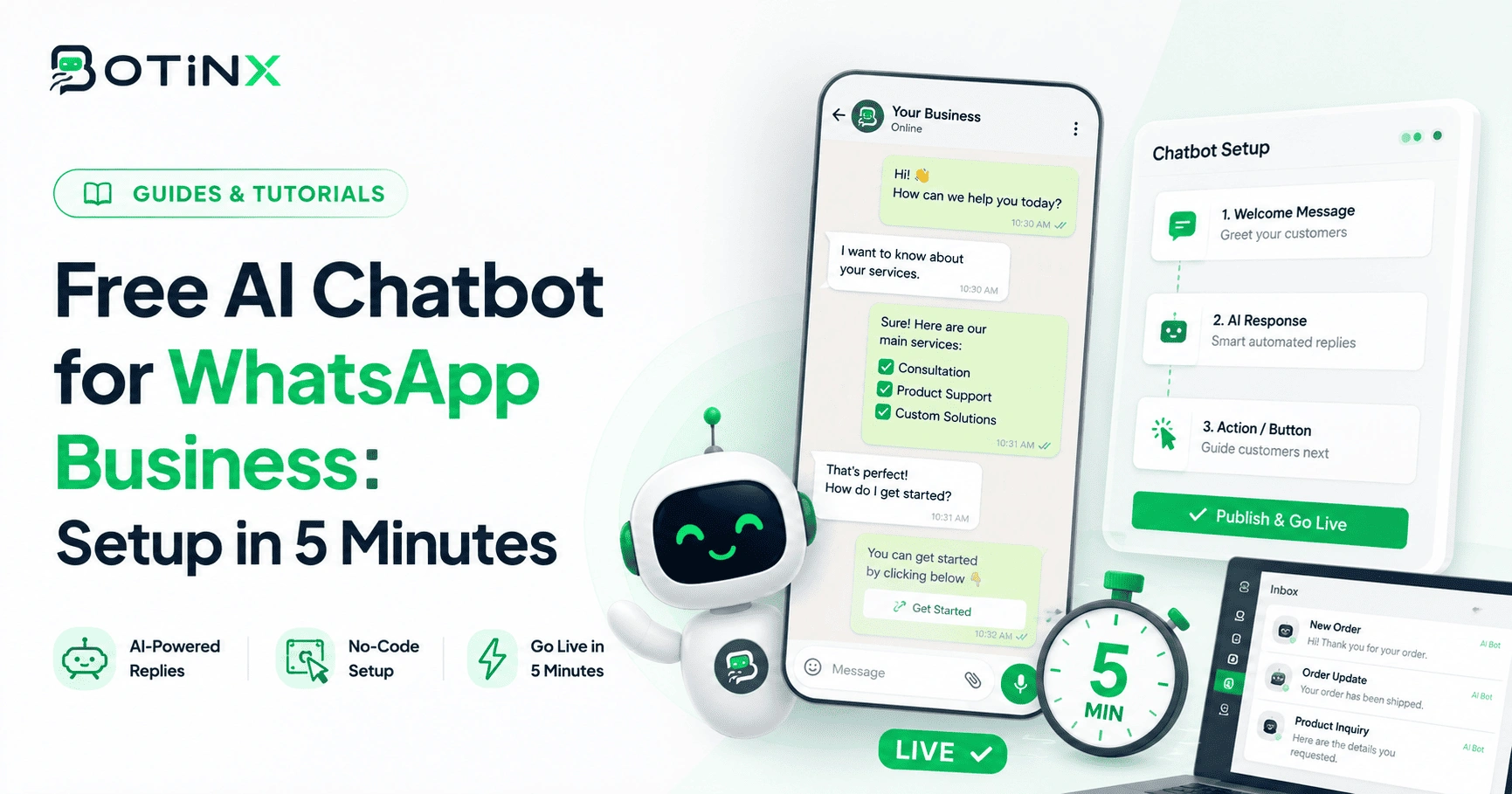
What does a free WhatsApp AI chatbot really include?
A free trial, a limited free plan and a completely free production service are different offers. Check what is included: test contacts, connected numbers, AI usage, team access and duration. Messaging charges or external AI costs may still apply even if the software trial has no subscription fee.
Start by evaluating Botinx AI agents against a small support use case, and confirm the current offer on the pricing page. Avoid choosing a chatbot because it promises setup in a few minutes. A connection can be quick, but preparing reliable answers and testing customer-facing behavior requires deliberate work.
Define the first job before choosing the technology
Choose a bounded task such as answering delivery-area questions, explaining business hours or directing customers to the right support team. Write down which facts the assistant can use and which questions require a person. A narrow, well-tested assistant is easier to evaluate than one expected to answer everything.
Also distinguish a rule-based flow from an AI assistant. A flow is useful when the questions and next steps are predictable. AI can help interpret varied wording, but its answers need grounding and review. A combined approach often works: structured steps for collecting information, with AI for explaining approved content and a clear route to human help.
Prepare a small, trustworthy knowledge base
Create a concise document containing current opening hours, service areas, product descriptions, delivery terms and contact routes. Remove expired offers and conflicting versions of policies. Give each topic a clear heading so a reviewer can find and correct the source information easily.
Do not upload secrets or unnecessary customer records. An assistant answering general questions does not need payment credentials or a full customer database. If an answer depends on a live order, use an authorized integration or a human agent rather than asking the model to infer the status. Assign one person to maintain the knowledge as policies change.
Write behavior instructions with explicit boundaries
Tell the assistant who it represents, the tone to use, the source of approved facts and when to escalate. A useful instruction is: “Answer using our approved support information. If the answer is missing or depends on a customer's account, explain that and offer human assistance. Do not invent availability, refunds or delivery dates.”
Keep action workflows separate from answer wording. Updating an order, issuing a payment link or booking an appointment requires a configured, authorized process. Adding “book appointments” to a prompt does not prove that a calendar integration exists or that a booking has been confirmed.
Test more than the questions you expect
Prepare a test set with straightforward questions, spelling mistakes, Hinglish phrasing, missing facts and contradictory requests. Include customers asking for a discount that does not exist, requesting a human and changing the subject midway. Evaluate factual correctness, usefulness and appropriate escalation separately.
For each failure, note whether the source document was incomplete, the instruction was ambiguous or the workflow was missing. Correct the underlying issue and repeat the failed case. Do not judge the system only by its best demonstration. A trial is valuable because it reveals where the assistant needs boundaries before real customers depend on it.
Verify handover and operational ownership
When a customer asks for a person or an agent takes over, confirm that automated responses stop and the human receives the conversation context. In Botinx, human control should remain in place until the conversation is explicitly resolved or closed; the messaging window is a separate concern.
Assign an owner for unanswered questions and review the first live conversations. Start with a small audience or a limited support topic. If the assistant repeatedly gets a policy wrong, pause that behavior and correct the source rather than letting it continue because the responses sound confident. Keep a clear way for customers to reach your team.
Estimate production cost and value
List the software fee, expected AI usage, messaging charges and the staff time required for review. Compare these costs with useful outcomes such as correctly resolved questions and reduced handling effort. An automated reply that creates extra work should not count as a successful resolution.
For example, track how many test conversations were answered correctly, how many required handover and how many contained a factual error. These are your own evaluation results, not a promise of industry-wide performance. Use the AI training guide for a more detailed rollout and maintenance process.
Questions to ask during the trial
Is the assistant free forever? Check the current plan terms and usage limits; do not infer this from a free signup button.
Can AI guarantee no incorrect answers? No. Grounding, testing and human escalation reduce risk but do not make generated answers infallible.
Can it work without the API? Confirm the connection method. Business App features and third-party API assistants are different products. Review the App vs API guide and WhatsApp messaging policy before launch.