Training starts with the information you approve
For a business support assistant, “training” often means configuring behavior and supplying approved knowledge rather than retraining a foundation model. The assistant needs current facts, clear boundaries and a route to a person when it cannot safely answer. Uploading a large document does not automatically produce reliable support.
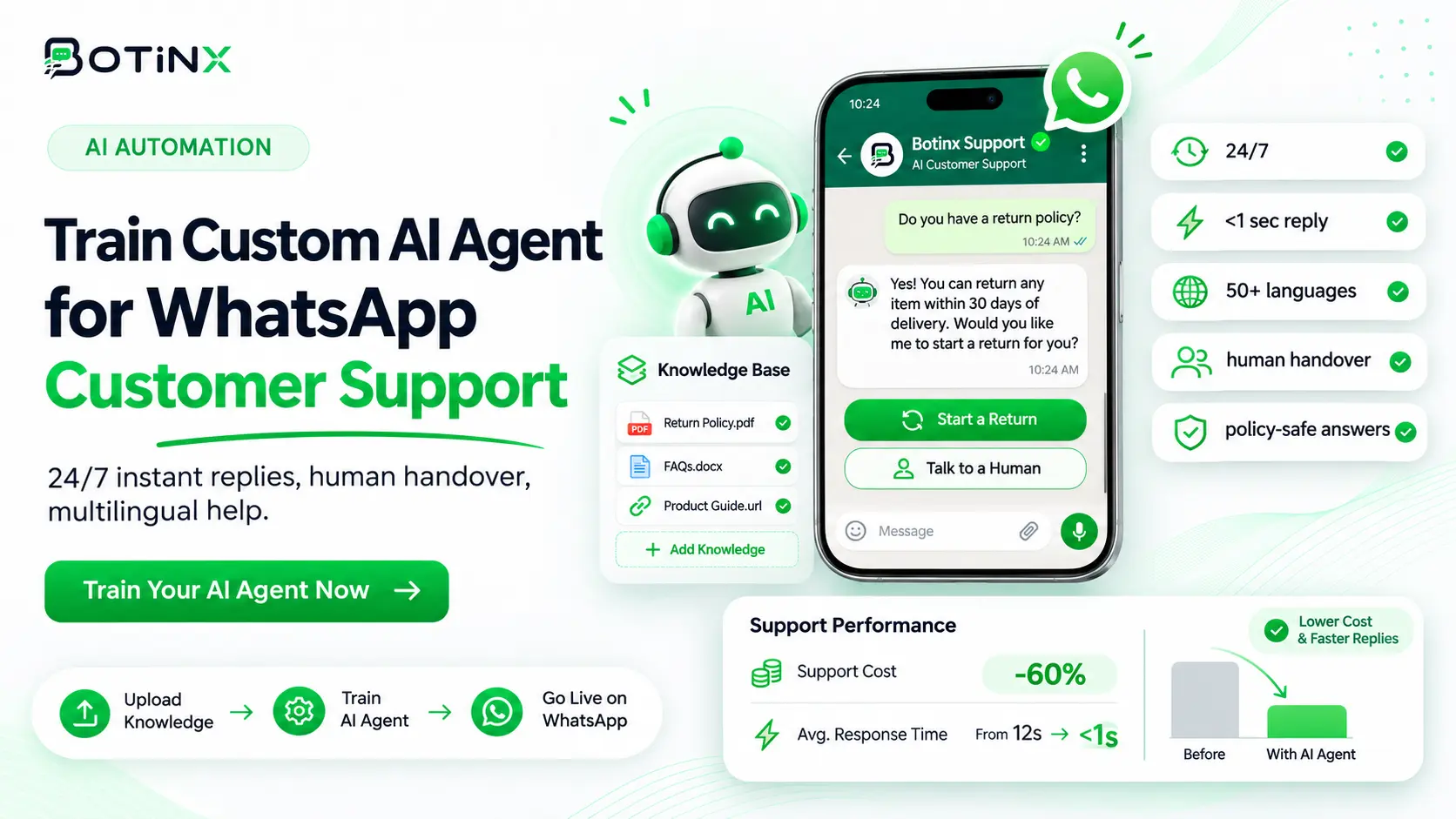
Start with Botinx AI agents and a narrow support scope. Choose a topic such as shipping questions or product selection. Define what a correct answer looks like before testing. This gives your team a standard for evaluating responses instead of judging the assistant by fluency or enthusiasm.
Audit your source material before adding it
Collect the current policies, product information and service details the assistant is allowed to use. Remove obsolete promotions, duplicate documents and contradictory versions. Identify who owns each source and when it should be reviewed. A clear, concise knowledge base is easier to maintain than a collection of unreviewed exports.
Separate general information from customer-specific data. Public delivery policy can live in a knowledge document; a particular customer's order status requires an authorized lookup or human support. Do not upload credentials, payment secrets or unnecessary personal records. The assistant should have access to the information needed for its job, not every file the company possesses.
Structure knowledge so answers can be checked
Organize content by topic with direct questions and factual answers. For example: “Which areas do we serve?”, “How do customers request a return?” and “What should happen when a delivery is delayed?” Include conditions and exceptions where they affect the answer.
Avoid vague statements such as “we always deliver quickly.” Use the actual policy and explain when a human must confirm a date. If two products have different terms, name the product in each entry. When a fact changes, update the authoritative entry instead of adding another paragraph that contradicts the old one. Keep a review date in your source-management process.
Write a plain-language behavior prompt
A practical starting instruction is: “You are the support assistant for our business. Answer using the approved knowledge. Be concise and ask for clarification when the question is ambiguous. If the information is missing or needs account access, explain the limitation and offer human assistance. Do not invent discounts, stock levels, refund approvals or delivery commitments.”
Add the language and tone your customers expect. Specify the conditions for escalation, such as complaints, requests for an agent or conflicting information. Avoid stuffing operational instructions into a long personality description. The business should be able to read the prompt and understand what the assistant is expected to do.
Keep answers separate from business actions
An answer about booking is different from creating a confirmed booking. In Botinx, structured forms, CRM calls, integrations and other actions belong in configured automation workflows. A sentence in the prompt does not create an integration or grant permission to change customer records.
For each action, define the required inputs, authorization and confirmation step. Do not tell a customer that an order was changed until the system reports a successful change. If an integration fails, explain the next step and hand over when needed. This separation makes errors easier to diagnose: incorrect knowledge and a failed business operation need different fixes.
Build a representative evaluation set
Use real question patterns with customer details removed. Include common questions, spelling variations, Hinglish phrasing, ambiguous requests and questions outside the approved scope. Add adversarial but realistic cases, such as asking the assistant to ignore the policy or approve an unavailable discount.
For each case, record the expected factual points, acceptable uncertainty and whether handover is required. Score correctness, completeness, tone and action accuracy separately. A friendly but incorrect answer should fail. Include multi-turn conversations where the customer changes a product or asks a follow-up, because isolated questions do not expose every context-handling problem.
Test human handover as a required capability
Ask explicitly for a person, trigger a policy exception and have an agent reply from the inbox. Confirm that AI and automation stop when human control is active. In Botinx, that control should remain until the conversation is explicitly resolved or closed; a messaging-window change should not restart the assistant by itself.
The human agent should receive the conversation and relevant context, not only a notification that “AI failed.” Test after-hours behavior as well. If no person is immediately available, the assistant should state a realistic expectation and collect only what is needed for follow-up. Do not promise an immediate response the business cannot provide.
Launch gradually and review failures by cause
Start with internal tests, then a limited live scope. Review a sample of conversations and all reported factual errors. Group failures into missing knowledge, stale information, unclear instructions, retrieval problems, workflow failures and handover failures. Fix the relevant layer rather than adding more instructions to every problem.
Repeat failed cases after each change and keep a small regression set of important policies. If a change improves one answer but breaks another, investigate before broadening access. Track correctly resolved conversations and useful escalations separately. A high volume of automated replies is not the same as a high volume of solved customer problems.
Maintain the assistant as the business changes
Assign an owner for knowledge updates and establish review triggers: a price change, new product, holiday hours or revised returns policy. Check that obsolete information has been removed from all active sources. Record the version or date used during an evaluation so results can be interpreted later.
Review costs alongside quality. Include AI usage, messaging and staff review time. Avoid promising a fixed automation rate or “zero hallucinations.” A more useful goal is reliable handling of the approved scope, honest uncertainty outside it and a smooth transition to a person when needed.
Training questions and related resources
Do I need complex JSON instructions? Botinx's business-facing configuration uses a plain-language behavior prompt and approved knowledge; structured actions belong in automation configuration.
Can documents supply live stock or order status? A static document cannot establish current customer-specific state. Use an authorized integration or a person.
What should I read next? Review AI chatbot trial evaluation, Botinx automation and the WhatsApp messaging policy. Test the full customer experience before increasing the assistant's scope.