
Optimize waste, not just the price of one message
Lower WhatsApp spending is useful when it preserves or improves customer outcomes. Sending fewer necessary updates can increase support work, while sending cheap but irrelevant messages still wastes money. Start with the relationship between spend, qualified conversations and completed business goals.
Use Botinx campaign tools and your billing records to identify where messages originate. This article focuses on an existing operation. If you are still estimating your first budget, begin with the separate WhatsApp API pricing breakdown, which explains subscriptions, messaging charges and other cost layers.
Build a baseline from actual delivery and invoice data
Choose a representative reporting period and group usage by campaign, workflow, destination market and message category. Compare delivery records with billed usage, accounting for timing differences and provider-specific charges. Keep platform subscription and implementation costs separate so they are not confused with message charges.
Record total spend, delivered messages, useful replies and completed goals. If attribution is incomplete, mark that limitation rather than assigning all revenue to messaging. A baseline should help explain where money goes and which outcomes are observed. It does not need to create a flattering return-on-investment number before the data supports one.
Remove duplicate and obsolete sends
Inspect repeated workflow triggers, duplicate imported contacts and overlapping campaign audiences. Use stable event identifiers where integrations support them. Check whether a retried event creates another message instead of being recognized as the same request.
Add suppression for completed goals. A customer who already purchased should leave checkout recovery; a confirmed booking should stop an invitation sequence. Recheck state immediately before sending because it can change after a delay begins. Review failed deliveries individually by cause rather than retrying all failures indefinitely. The correct response to a policy restriction is not repeated paid attempts.
Improve audience relevance
Separate customers by the reason they would value a message. Use recent, reliable signals such as a requested update or a relevant product interest rather than assuming every stored contact is equally interested. Remove opted-out contacts and investigate segments with unusually high negative feedback.
For a controlled experiment, compare a targeted audience with your previous broad approach using the same business objective. Examine cost per useful reply or order, not just the size of the audience reached. Lower volume can be a successful outcome if it reduces waste while preserving results. Keep the decision grounded in your own data rather than a promised universal savings percentage.
Review category and timing assumptions honestly
Ensure the message category reflects the actual content. Do not disguise a promotion as a utility update to reduce the rate. If a template is reclassified, update the forecast and review the reason. Keep the current approved category with your campaign records.
Check current pricing conditions for service windows, free-entry opportunities and any applicable volume tiers. The messaging window is not a blanket declaration that all costs disappear, particularly when provider charges are separate. Use Meta's current pricing page and your invoice to verify assumptions before changing a workflow around expected savings.
Reduce unnecessary follow-ups and support effort
Review each step of a drip sequence. Does it answer a new question, move a requested process forward or simply repeat the previous message? Remove steps that add cost and irritation without useful outcomes. Make links and instructions clear enough that customers do not need several extra messages to complete a simple task.
Use AI for approved explanatory content where it helps, but count incorrect answers and escalation effort in the cost. A misleading automated answer can create more support work than it saves. Keep human takeover available and use the drip campaign playbook to implement reliable stop conditions.
Work through an illustrative savings calculation
Suppose an audit finds 1,200 duplicate billable deliveries in a month. At an assumed unit cost of ₹0.80, eliminating those duplicates would remove ₹960 of messaging charges under that simplified scenario. The rate and volume are illustrative, not current pricing or a Botinx customer result.
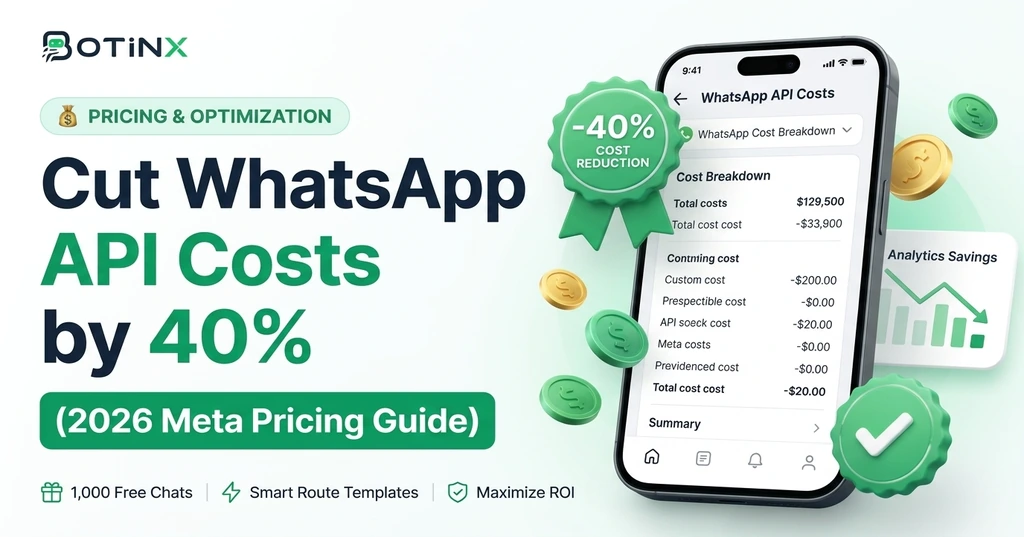
Now include any implementation effort and confirm that the removed messages were genuinely unnecessary. If fixing the workflow also reduces support complaints, record that separately. Do not turn one example into a claim that every business can cut costs by 40%. The amount depends on the waste present in the original process and the actual rates applied.
Reconcile and review every month
After changes, compare the same definitions over comparable periods. Account for seasonality, audience size and changes in the offer. A quieter sales month can lower spending without indicating a better workflow. Maintain a small change log so the finance and marketing teams understand what changed and why.
Should I always choose the lowest-cost provider? Compare the total workflow, support burden and contract terms as well as fees.
What is the best first action? Find duplicate sends and missing purchase or opt-out exits. These are often easier to verify than speculative pricing “hacks.” Review Botinx pricing and the messaging policy alongside your actual billing records.