What a Story mention automation responds to
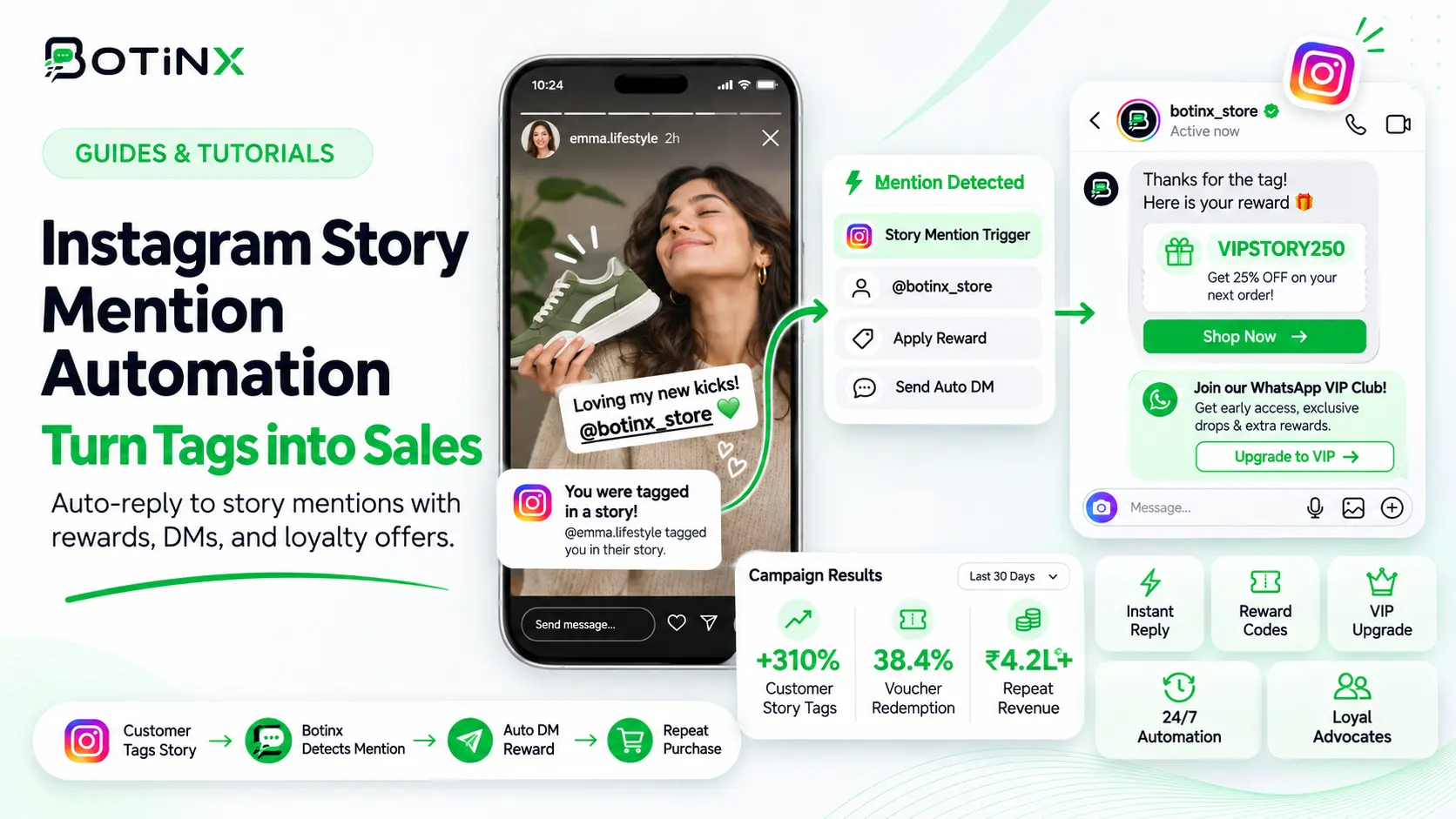
A Story mention automation reacts to an eligible event in which someone mentions your business account in a Story. It is different from a Story reply, a comment on a Reel or a new follower event. Each has its own trigger and supported messaging behavior.
Use Botinx's Instagram automation workflow to acknowledge a genuine mention and offer a useful next step. Start with a simple thank-you rather than assuming every mention deserves a coupon or sales sequence. The goal is to recognize the customer without turning a friendly interaction into repeated unwanted messages.
Check eligibility instead of assuming every mention arrives
Verify the connected Instagram account, its permissions and the events supported by the integration. Do not promise that private-account mentions will always trigger an automation. Event availability can depend on the account and channel rules, and a mention visible in the native app is not proof that the same event is exposed to your software.
As one documented example, Manychat's Story mention trigger guide specifies public-profile mentions for its trigger. Treat that as information about that provider's implementation, not a guarantee about every tool. Test the actual Botinx account and configuration you intend to use.
Write a response that acknowledges the real context
A useful initial message is: “Thanks for mentioning us in your Story. We appreciate it! If you have a question about your order or product, our team can help here.” Keep it truthful. Unless the system has reliable access to the content, do not claim to have watched the video or describe what the person was wearing.
If you want to share the customer's content, ask for appropriate permission rather than treating the mention as automatic approval for every reuse. Keep support requests separate from promotional responses. A customer mentioning your brand to report a problem should receive help, not a cheerful discount pitch that ignores the complaint.
Configure the trigger and test a single path
Connect the intended account in Botinx, select the supported Story mention trigger and prepare the reply. Confirm whether the rule applies broadly or only under specific conditions. Test with an eligible internal or controlled account and inspect the received event and delivered message.
Then test a Story reply separately to ensure the two event types are not confused. Review overlap with default DM rules so one mention does not generate several responses. If the event does not appear, investigate account access and supported behavior before changing the reply copy or repeatedly reconnecting the account.
Use rewards only with clear rules
If you offer a reward, define eligibility, redemption conditions and how repeated mentions are handled. Use a real code that the commerce system accepts, and avoid suggesting that Botinx creates a unique coupon unless that integration is configured and verified.
Keep a record of issued rewards if duplicate claims matter. Test the available cooldown or deduplication behavior instead of assuming a particular limit is built in. Do not promise cashback before the payment and eligibility process exists. A simple thank-you is often easier to operate reliably than a reward program that creates manual disputes.
Respect handover and cross-channel permission
When a person asks for help or a team member replies, pause competing automated messages. Preserve the mention context for the agent so the customer does not need to explain the entire interaction again. Use honest availability messaging if the team cannot respond immediately.
If you invite the customer to WhatsApp, make the invitation optional and explain what they will receive. Do not enroll the Instagram account or a discovered phone number into WhatsApp promotions automatically. Channel engagement, customer identity and marketing permission are different concepts and should be handled separately in your contact process.
Measure outcomes without inventing revenue claims
Track eligible mention events, replies sent, customer responses, support requests and verified reward redemptions. If you attribute orders, define the attribution window and how the order is linked to the interaction. A coupon redemption does not by itself prove the automation caused a new purchase.
Review the nature of mentions as well as volume. Some are compliments, some are questions and some are complaints. A system that replies quickly but mishandles negative feedback is not performing well. Use qualitative review alongside counts, and avoid publishing a dramatic revenue case study without records and customer approval supporting it.
Troubleshooting and common questions
Why did a mention not trigger? Check account eligibility, connection permissions, event type and whether the event reached the integration. Private-account visibility can differ from supported automation events.
Why did the person receive two replies? Inspect repeated events and overlapping Story or DM rules.
Can I reuse every mentioned Story? Seek appropriate permission for your intended use rather than assuming the tag grants it.
For related workflows, read the comment-to-DM guide, Manychat's feature overview and Botinx automation information. Test your specific setup before a public campaign.