Why measuring WhatsApp ROI is different from traditional channels
Measuring Return on Investment (ROI) for WhatsApp marketing requires a paradigm shift from traditional channels like email or SMS. Unlike legacy platforms where marketing, sales, and support operate in silos, WhatsApp blends all three disciplines into a single continuous conversation. A single message thread might start as a promotional broadcast, evolve into a product inquiry handled by sales, and conclude with post-purchase support.
This unified experience makes traditional attribution models challenging, but ironically, it also enables far more accurate tracking. Because every interaction—from the initial delivery to read receipts, link clicks, and eventual conversion—happens within a closed, trackable ecosystem, you have unprecedented visibility into user behavior. When integrated with a robust contacts CRM, WhatsApp transforms from a simple messaging tool into a comprehensive revenue attribution engine.
Furthermore, WhatsApp\'s conversational nature means you\'re measuring not just immediate sales, but the accumulation of zero-party data and customer relationship value. The engagement depth is fundamentally different; a customer replying to a WhatsApp campaign indicates a level of intent that a mere email open simply cannot match.
The 5 essential WhatsApp marketing metrics
To accurately calculate your ROI, you must first master the fundamental metrics that drive WhatsApp performance. These five indicators provide the baseline data needed for your final calculations.
- Delivery Rate: The percentage of messages successfully delivered to users\' devices. A healthy rate is typically above 98%. Lower rates might indicate stale phone numbers or users who have disconnected from the platform.
- Read Rate: A metric completely unique to instant messaging. This indicates how many users actually opened your message. While email struggles to hit 20% open rates, WhatsApp consistently delivers read rates between 60% and 80%.
- Click-Through Rate (CTR): The percentage of users who clicked a link within your message. This is a strong indicator of offer relevance and copy effectiveness.
- Conversation-to-Sale Conversion Rate: How many engaged conversations ultimately resulted in a closed sale. This is where your sales team or AI agents prove their worth.
- Customer Lifetime Value (CLTV): The total revenue expected from a customer over their entire relationship with your brand, heavily influenced by WhatsApp retention campaigns.
| Metric | Email Benchmark | WhatsApp Benchmark |
|---|---|---|
| Open/Read Rate | 15-22% | 60-80%+ |
| Click-Through Rate | 2-5% | 15-35% |
| Conversion Rate | 1-3% | 5-15% |
The ROI formula: Step-by-step calculation with worked example
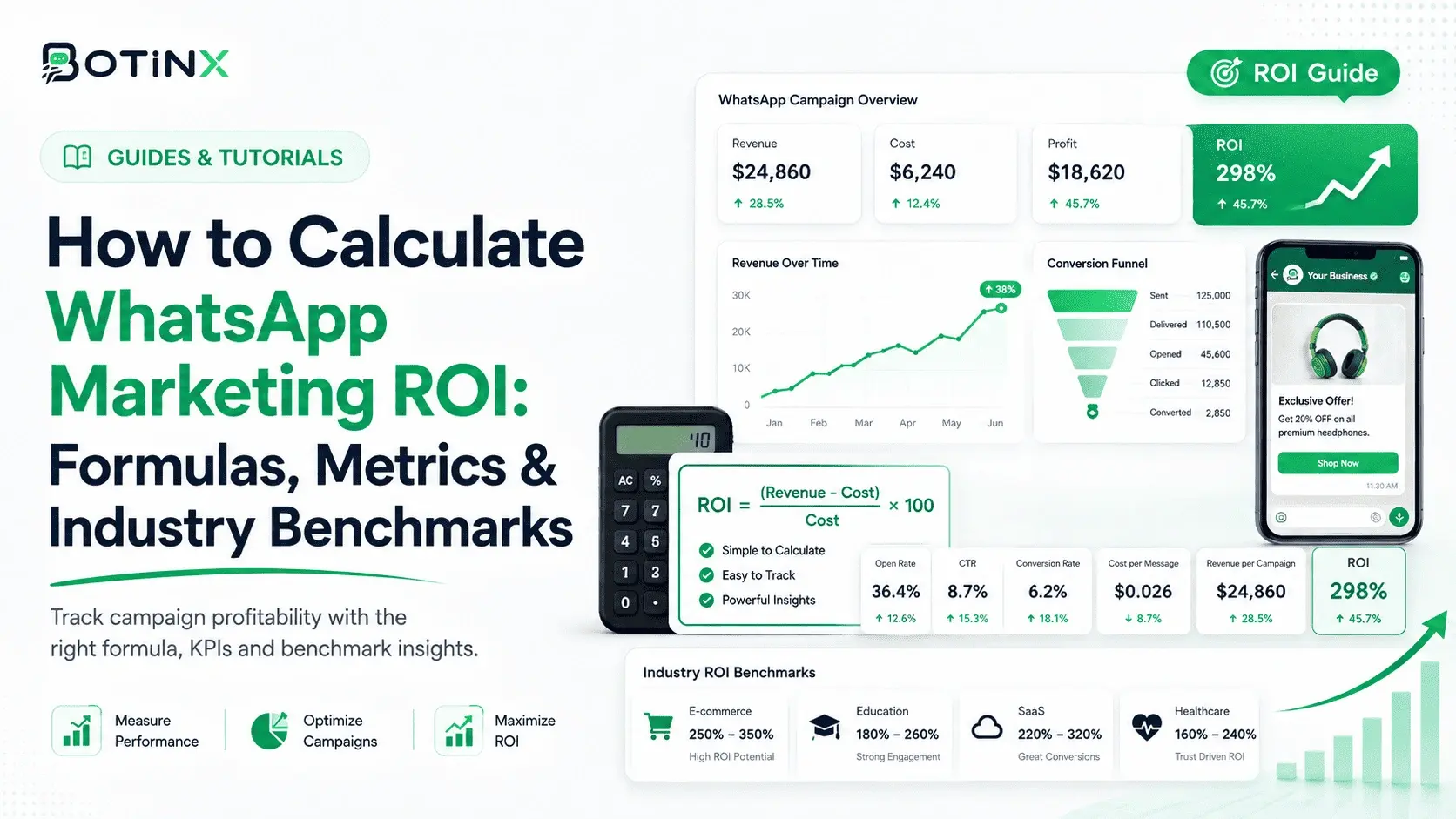
The core formula for WhatsApp marketing ROI is straightforward: ROI = [(Revenue from WhatsApp - Total WhatsApp Cost) / Total WhatsApp Cost] × 100. However, the true value lies in correctly attributing both the revenue and the comprehensive costs associated with your campaigns.
Let\'s walk through a concrete example to illustrate the phenomenal returns possible. Imagine you run a broadcast campaign sending 10,000 marketing messages. Out of these, 9,800 are delivered, and 9,600 are read by your audience. Thanks to compelling copy and a strong offer, you achieve a 15% click-through rate, resulting in 1,440 clicks. From those clicks, 20% convert into purchases, yielding 288 distinct orders.
If your average order value is ₹3,000, your total revenue generated is ₹8.64 lakh. On the cost side, assuming a flat rate of ₹0.86 per marketing message, your total messaging cost is ₹8,600. Plugging this into our formula: [(8,64,000 - 8,600) / 8,600] × 100. This results in an astonishing ~9,946% ROI, effectively a 100x return on your messaging spend. Even factoring in platform subscription costs, the margins remain incredibly robust.
Understanding Meta's messaging costs in 2026
To calculate ROI accurately, you must understand how Meta charges for WhatsApp Business API usage in 2026. Costs are based on 24-hour conversation windows, not individual messages, and are categorized by the type of template initiating the conversation.
There are four distinct conversation categories. Marketing conversations (promotions, offers, newsletters) are the most expensive, typically costing around ₹0.86 per conversation in India. Utility conversations (order updates, shipping alerts) are cheaper at approximately ₹0.115. Authentication conversations (OTPs, account verification) are priced identically to utility at ₹0.115.
The fourth category, Service conversations, are user-initiated interactions. Historically free within a 24-hour window, note that pricing models are evolving in late 2026. However, Click-to-WhatsApp (CTWA) ads continue to offer a generous 72-hour free messaging window, making them a highly cost-effective strategy for top-of-funnel acquisition when paired with an effective shared team inbox to handle the influx of queries.
ROAS benchmarks by industry
Return on Ad Spend (ROAS) and overall ROI can vary significantly depending on your vertical, product price point, and sales cycle length. Understanding industry benchmarks helps set realistic expectations for your campaigns.
Here is a breakdown of typical WhatsApp ROAS benchmarks we observe across different sectors:
| Industry Vertical | Average ROAS | Key Drivers |
|---|---|---|
| E-commerce & D2C | 15x - 30x | Impulse buys, cart recovery, high repeat purchase rate |
| Real Estate | 8x - 15x | High ticket size, longer nurturing cycles, brochure downloads |
| Education & EdTech | 10x - 20x | Lead qualification, webinar reminders, enrollment deadlines |
| Healthcare | 5x - 10x | Appointment bookings, report delivery, consultation follow-ups |
| Events & Entertainment | 12x - 25x | Flash sales, urgent notifications, VIP access |
Variance within these ranges is usually driven by the quality of the contact list and the level of personalization. A highly segmented list using CRM data will consistently hit the upper tier of these benchmarks compared to generic batch-and-blast campaigns.
The attribution gap: Connecting WhatsApp conversations to actual revenue
The biggest challenge in measuring WhatsApp ROI is the "attribution gap." Unlike a website where tracking pixels follow a user\'s every move seamlessly, WhatsApp conversations happen in a private environment. If a user receives a WhatsApp message, switches to their laptop, and makes a purchase, the standard metrics might not connect the dots.
To solve this, savvy marketers employ a multi-layered attribution strategy. The foundation is using UTM parameters on all click-tracking links sent via WhatsApp. This allows your web analytics platforms (like Google Analytics) to attribute specific sessions and conversions directly back to specific WhatsApp campaigns.
For deeper integration, utilizing CRM tagging and the Meta Conversions API (CAPI) bridges the gap between offline interactions and online sales. The Botinx analytics dashboard automatically handles much of this heavy lifting, unifying conversation data with conversion events to provide a true picture of revenue impact without the typical dark social attribution loss.
5 proven levers to double your WhatsApp marketing ROI
Once you are measuring ROI accurately, the next step is optimization. Here are five proven levers to dramatically increase your returns on WhatsApp:
- Micro-segmentation by purchase history: Stop sending generic offers. Use your CRM data to send highly targeted cross-sell and up-sell campaigns based on past buying behavior. Relevance drives conversion.
- AI-powered instant response: Speed kills the competition. Deploy AI agents to ensure every customer inquiry receives a comprehensive response within 30 seconds, dramatically reducing drop-off rates.
- Optimal broadcast timing: Timing is everything. Analyze your industry data to send messages when your specific audience is most active and likely to convert.
- 3-tier cart recovery sequences: Implement an automation builder sequence that triggers 1 hour, 12 hours, and 24 hours after a cart is abandoned, scaling the urgency and incentive with each message.
- Re-engagement of dormant subscribers: Reactivating a cold lead is infinitely cheaper than acquiring a new one. Run specific, high-value campaigns targeted exclusively at users who haven\'t interacted in the last 60 days.
Implementing even two or three of these strategies can routinely double the baseline ROI of your WhatsApp marketing efforts.
Using Botinx analytics to track and optimize campaign performance
Manual calculation is fine for periodic reviews, but scaling your WhatsApp operations requires real-time visibility. Botinx provides a comprehensive suite of analytics and reporting tools designed specifically for the nuances of conversational commerce.
Our real-time dashboards give you instant feedback on delivery rates, read rates, and link clicks as campaigns unfold. You can drill down into per-template benchmarks to see exactly which messaging variations resonate best with different audience segments, allowing for rapid A/B testing and iteration.
Beyond campaign metrics, Botinx also tracks agent performance within your shared inbox. You can monitor response times, resolution rates, and sales conversions attributed to specific team members or AI bots. This granular data ensures that every rupee spent on messaging is optimized for maximum return.
Template: Monthly WhatsApp marketing cost vs revenue projection
Ready to project your own ROI? Use this simple framework to model your expected monthly returns. This template helps secure budget approvals and sets clear performance targets for your team.
- Step 1: Calculate Total Cost
(Projected Monthly Messages × Cost Per Message) + Fixed Platform Costs = Total Monthly Cost - Step 2: Calculate Projected Revenue
(Projected Messages × Expected Read Rate % × Expected CTR % × Expected Conversion Rate %) × Average Order Value = Total Monthly Revenue - Step 3: Calculate ROI
[(Total Monthly Revenue - Total Monthly Cost) / Total Monthly Cost] × 100 = Monthly ROI %
By regularly updating these projections with actual historical data from your Botinx dashboard, you can build highly accurate revenue forecasts that demonstrate the undeniable value of your WhatsApp marketing strategy. Ready to start measuring? Sign up for Botinx today and take control of your conversational revenue.