The 2026 messaging landscape: Why this comparison matters now
As we navigate through 2026, the digital marketing landscape has undergone a profound shift. Traditional email marketing, once the undisputed king of digital communication, is facing unprecedented challenges. Consumers are experiencing severe email fatigue, with the average person receiving over 120 promotional emails daily. The sheer volume of noise in the standard inbox makes it increasingly difficult for brands to stand out and capture their audience's attention.
Simultaneously, we have witnessed the absolute dominance of mobile-first consumers. With over 2.7 billion active users globally, WhatsApp has evolved from a simple peer-to-peer messaging app into a robust commercial ecosystem. People now expect to communicate with businesses the same way they chat with their friends and family: instantly, seamlessly, and on their most preferred platform. This shift in consumer behavior means that businesses can no longer rely solely on legacy channels if they want to drive meaningful growth.
For marketing teams and growth leaders, this transition necessitates a critical reevaluation of the channel mix. Sticking to strategies that worked in 2020 is a recipe for diminishing returns. Understanding the nuances, strengths, and conversion capabilities of both WhatsApp and email is crucial. This comparison will dissect the hard data behind both channels, demonstrating why a strategic pivot toward conversational commerce is not just an option, but a necessity for surviving and thriving in today's hyper-competitive market.
Open rates and read rates: WhatsApp (98%) vs Email (21%)
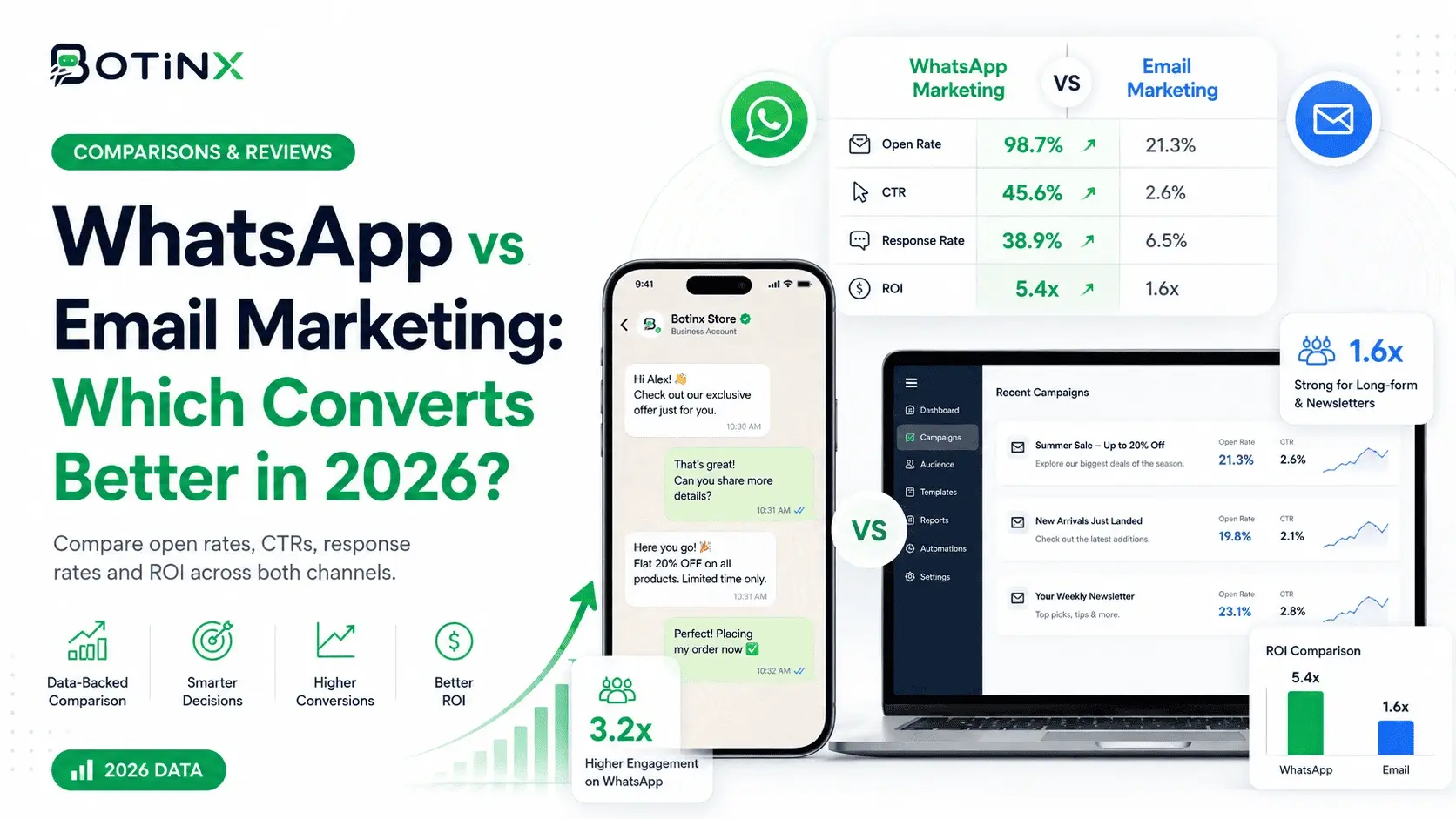
When it comes to pure visibility, the data presents a stark contrast between WhatsApp and email marketing. The cornerstone of any successful campaign is ensuring your audience actually sees your message. Currently, standard email marketing campaigns struggle with an average open rate hovering around 20% to 21%. Even highly optimized, segmented lists rarely break the 30% threshold. This means that for every 1,000 emails sent, nearly 800 are ignored, deleted without reading, or lost in the abyss of secondary tabs.
In sharp contrast, WhatsApp boasts an astonishing open rate of 98%. The platform's personal nature and the immediacy of push notifications ensure that almost every message sent is seen by the recipient. Furthermore, the read rate speed is unparalleled. Industry data shows that on average, a WhatsApp message is opened and read within three minutes of delivery. This kind of instant visibility is a game-changer for time-sensitive promotions, flash sales, and critical alerts.
| Metric | Email Marketing | WhatsApp Marketing |
|---|---|---|
| Average Open Rate | 21% | 98% |
| Time to Open | 1-2 days | Under 3 minutes |
| Visibility | Buried in promotions tab | Lock screen push notification |
This massive disparity in open rates translates directly into better campaign performance. If you are launching a new product using a broadcast campaign, starting with an audience that guarantees 98% visibility provides a massive statistical advantage over relying on the fractional engagement of traditional email.
Click-through rates and engagement: Interactive buttons vs static links
Beyond just opening a message, the ultimate goal of any marketing communication is to drive action. Click-through rate (CTR) is where the modern capabilities of WhatsApp truly outshine the aging infrastructure of email. In a typical email campaign, marketers are thrilled to achieve a CTR of 2% to 3%. Users must open the email, scroll through the content, and hunt for a hyperlinked text or a static image button, all while dealing with varying rendering issues across different email clients.
WhatsApp revolutionizes engagement through its native interactive elements. Instead of static links, businesses can utilize interactive quick-reply buttons and clear call-to-action (CTA) buttons right within the chat interface. These elements reduce friction to zero. A user doesn't have to type out a response or navigate away from their messaging flow; they simply tap a button to confirm an order, book a demo, or claim a discount. Consequently, WhatsApp campaigns frequently see CTRs ranging from 45% to 60%.
Consider a cart recovery scenario. An email saying "You left something behind" with a link back to the site might convert at a low single-digit percentage. A WhatsApp message asking "Complete your purchase?" with interactive "Buy Now" and "Ask a Question" buttons transforms a static notification into a dynamic conversation. This interactive paradigm not only drives higher clicks but also fosters a deeper, more engaging relationship between the brand and the consumer.
Deliverability: Inbox placement vs spam folders
The hidden cost of email marketing is deliverability. You might craft the perfect email, but if it never reaches the primary inbox, it doesn't matter. Email marketers constantly battle a complex web of spam filters, ISP throttling, domain reputation issues, and the dreaded Gmail "Promotions" tab. Even legitimate, opt-in newsletters often get miscategorized as spam, silently destroying campaign ROI without the marketer ever fully realizing the extent of the problem.
WhatsApp fundamentally eliminates these deliverability hurdles. Because it operates on a closed ecosystem governed by Meta, there are no algorithmic sorting tabs or unpredictable third-party spam filters to navigate. When you send an approved template message to an opted-in user, it goes directly to their main chat screen alongside messages from their friends. The concept of a "Promotions tab" does not exist on WhatsApp.
This direct-to-consumer reliability is invaluable. As long as your business maintains a healthy quality rating and adheres to the opt-in policies, your deliverability rate remains near 100%. This predictability allows teams to accurately forecast campaign results and rely on the platform for critical communications, knowing that their investment in audience building won't be undermined by opaque inbox algorithms.
Cost comparison: Per-message fees vs flat email subscriptions
Pricing models between the two channels operate on entirely different philosophies, making direct comparisons challenging but necessary. Email marketing tools traditionally charge a flat monthly subscription based on the total number of contacts (e.g., $20 to $300+ per month for 10K to 100K subscribers). Once you pay this fee, you can theoretically send an unlimited number of emails, making the cost-per-send exceptionally low. This makes email highly cost-effective for mass, undifferentiated blasting.
WhatsApp Business API operates on a consumption-based, per-conversation pricing model. Meta charges based on the category of the conversation (Marketing, Utility, Authentication, or Service). For instance, in India, a marketing conversation might cost around ₹0.86, while a utility conversation costs ₹0.115. These are session-based fees covering a 24-hour window. While the upfront cost per message is higher than email, the cost must be evaluated against the conversion rate.
| Feature | Email Platforms | WhatsApp API |
|---|---|---|
| Pricing Model | Flat monthly fee (by contacts) | Per-conversation fee (24h window) |
| Volume Cost | Very low per send | Higher per send |
| ROI Metric | Low cost, low conversion | Premium cost, high conversion |
When calculating true ROI, WhatsApp often emerges as the winner despite the higher per-message cost. Spending $100 on WhatsApp messages that convert at 15% yields significantly more revenue than spending $10 on email blasts that convert at 0.5%. The key is treating WhatsApp as a premium channel for high-intent actions rather than a dumping ground for generic newsletters.
Rich media and interactivity: What each channel supports
The aesthetic and functional capabilities of a marketing channel dictate how well you can showcase your products. Email has long relied on HTML templates to create visually appealing layouts. Marketers can embed high-resolution images, format text creatively, and structure complex multi-column designs. However, email interactivity is severely limited. Embedded videos rarely work across all clients, and complex forms usually require redirecting the user to an external landing page, breaking the user experience.
WhatsApp takes a different, highly standardized approach. While you cannot create custom HTML layouts, WhatsApp supports a rich array of native media types that feel natural to the platform. Marketers can send crisp images, high-definition videos, PDFs, and even precise location pins. More importantly, WhatsApp excels in native interactivity. Features like product catalogs and multi-product carousels allow users to browse items directly within the chat.
Furthermore, businesses can deploy interactive list messages and utilize WhatsApp forms to collect user data without ever forcing them to leave the app. This native, streamlined experience reduces drop-off rates significantly. While email offers a blank canvas for design, WhatsApp offers a frictionless environment for action, proving that in 2026, seamless functionality often trumps elaborate graphics.
Automation capabilities: Drip campaigns and AI chatbots
Automation is the engine of scalable marketing. Email platforms have spent two decades perfecting the art of the drip campaign. Marketers can build complex, time-delayed sequences that nurture leads over weeks or months based on specific triggers and behaviors. These workflows are excellent for slow-burn education and long-term brand building, operating quietly in the background.
WhatsApp automation, however, brings automation into the era of real-time conversation. Using a powerful automation builder, businesses can construct dynamic chat flows that respond instantly to user inputs. Instead of waiting three days for the next email, a user can navigate through an entire qualification process in three minutes via automated WhatsApp menus and quick replies.
Moreover, the integration of AI agents elevates WhatsApp far beyond static email autoresponders. Intelligent chatbots can understand natural language, resolve complex customer queries, recommend products based on conversational context, and even process transactions autonomously. This transforms marketing from a one-way broadcast into a two-way, intelligent dialogue that converts at a much higher velocity.
Compliance and opt-in: Different rules for different channels
Navigating the regulatory landscape is essential for protecting your brand's reputation. Email marketing is governed by established laws like CAN-SPAM and GDPR. The general rule is that you must provide a clear way to unsubscribe and, depending on the jurisdiction, obtain consent before emailing. However, the enforcement can sometimes be lax, leading to the proliferation of purchased lists and unsolicited cold emails.
WhatsApp enforces an incredibly strict, platform-level compliance model. To send proactive marketing messages, businesses must strictly adhere to Meta's policies. First, you must obtain explicit, active opt-in from the user specifically for WhatsApp communications. Second, all proactive marketing messages must use pre-approved templates. Meta reviews these templates to prevent spam, scams, and overly aggressive promotional content.
Additionally, WhatsApp operates on a 24-hour customer service window. When a user sends a message, a business has 24 hours to reply with free-form text. Outside this window, only approved templates can be used to re-engage. While these rules require more upfront strategy and management using a robust contacts CRM, they guarantee a high-quality user experience. This strict environment is exactly why users trust WhatsApp and continue to engage with brand messages at such high rates.
When to use which: The hybrid funnel strategy
The conclusion drawn from this comparison is not that WhatsApp should completely replace email. Instead, savvy marketers in 2026 are adopting a hybrid funnel strategy, leveraging the unique strengths of both channels. Abandoning email entirely would mean losing a cost-effective tool for long-form content and broad brand awareness. Email remains excellent for detailed monthly newsletters, comprehensive product updates, B2B whitepaper distribution, and sending official receipts or invoices.
WhatsApp, on the other hand, should be deployed at the sharpest points of your conversion funnel. Use WhatsApp for scenarios where immediacy and high engagement are critical. This includes flash sales, VIP early access announcements, abandoned cart recovery, event reminders, and time-sensitive account alerts. It is the ultimate tool for bottom-of-the-funnel conversions and conversational customer support.
By enabling WhatsApp coexistence with your existing tech stack, you can orchestrate multi-channel campaigns. For example, send a long-form educational email on Monday, and follow up with a quick WhatsApp reminder containing an interactive purchase button on Thursday. Utilizing both channels strategically ensures you capture attention everywhere your customers spend their time, maximizing overall revenue.
How Botinx helps you maximize WhatsApp marketing ROI
Transitioning to a WhatsApp-first strategy requires the right infrastructure, and that is exactly where Botinx excels. As a comprehensive AI-first platform, Botinx provides all the tools you need to outmaneuver competitors who are still relying solely on legacy email systems. With our intuitive interface, you can launch high-converting broadcast campaigns to thousands of opted-in users in minutes, bypassing the spam folder entirely.
Beyond broadcasting, Botinx empowers your team to build sophisticated workflows. Utilize our visual automation builder to design custom chat flows, and deploy cutting-edge AI agents to handle customer inquiries and drive sales 24/7. When human intervention is necessary, the shared team inbox allows your entire sales and support staff to collaborate seamlessly on complex queries.
Stop leaving money on the table with ignored emails. Track every interaction with precision using our advanced click tracking and analytics reporting features. Ready to see the difference a 98% open rate can make for your bottom line? Explore our pricing, sign up for an account today, or contact our team to start building your ultimate conversational marketing funnel.